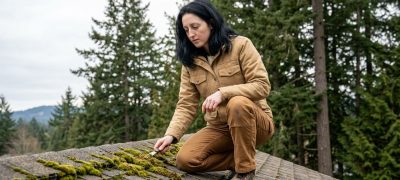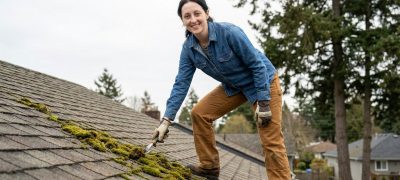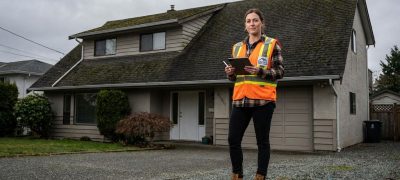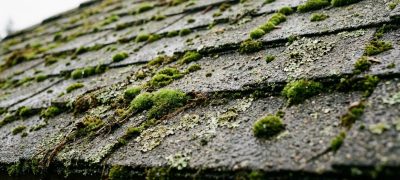

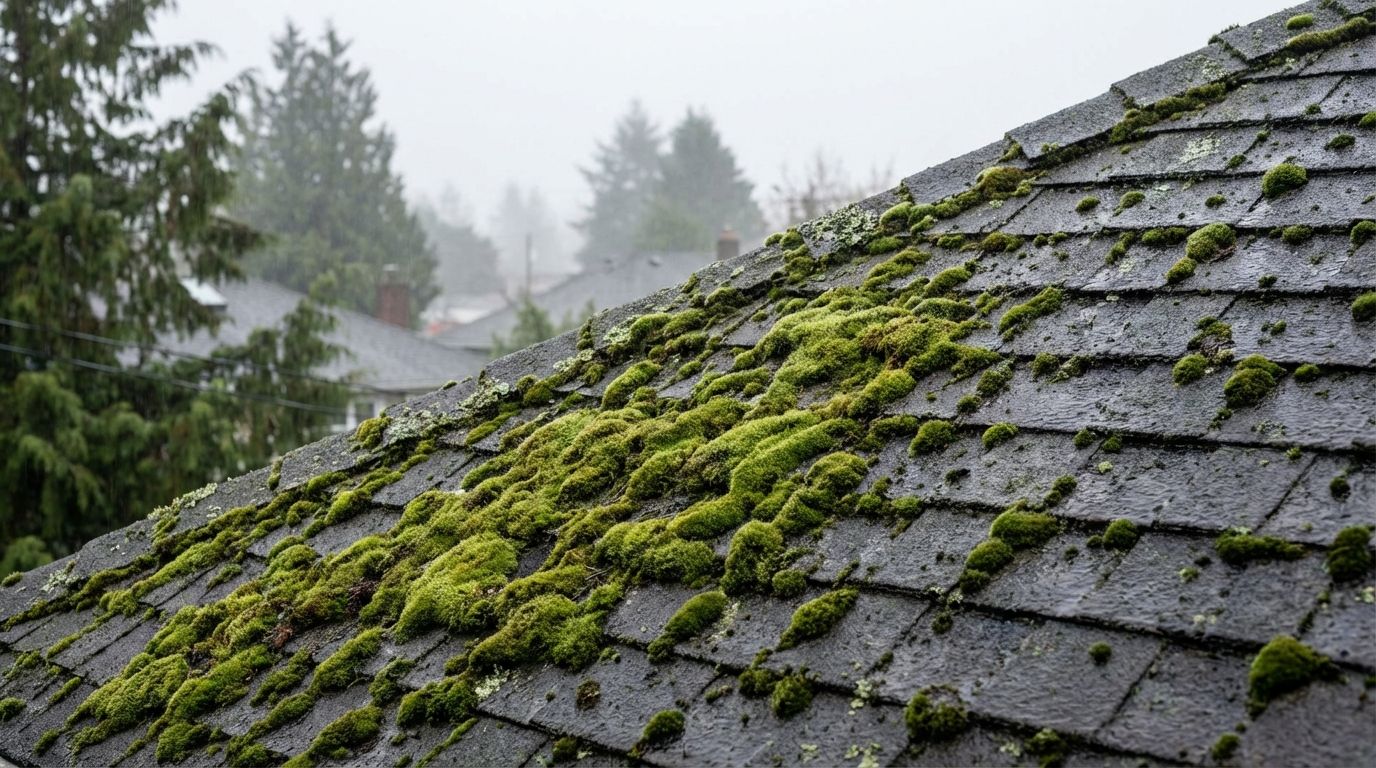
Is moss creeping back onto your roof again, even after you cleaned it not long ago?
In Victoria, BC, that’s a common story, and picking the right method matters. The choice between soft wash vs pressure wash can protect your roof, or quietly shorten its lifespan.
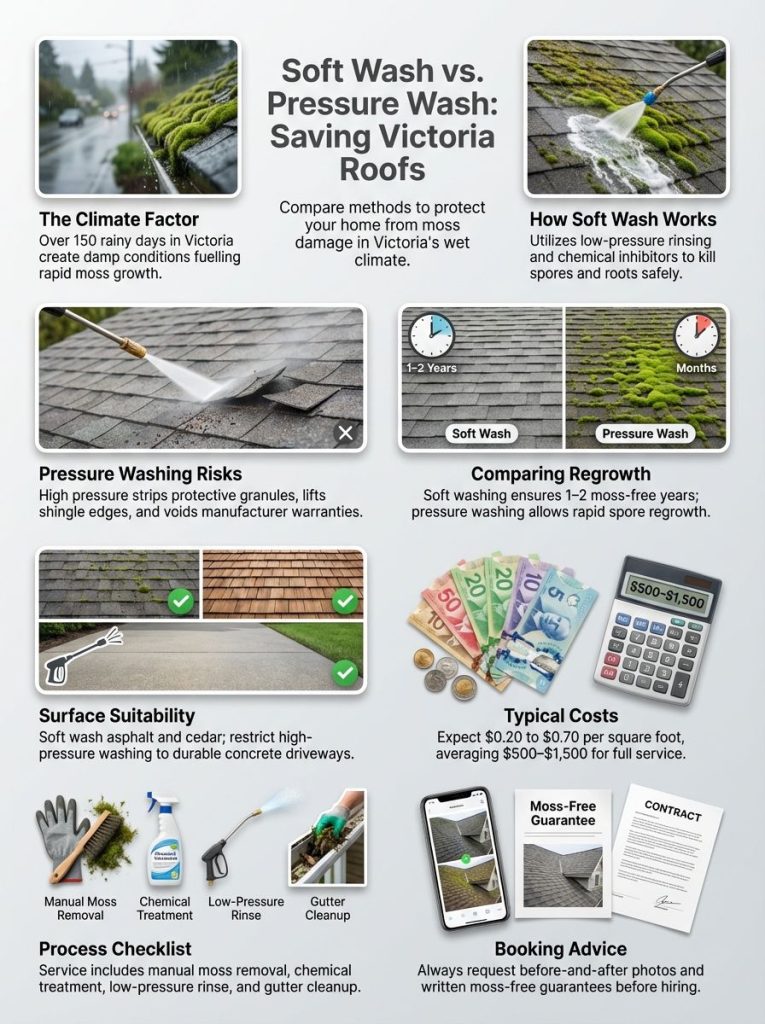
I work with Lipco Ltd, a family-owned renovation company in Greater Victoria, and I’ve spent years reviewing real roof cleaning scopes, so homeowners can avoid the “quick fix” that turns into a bigger repair.
If you want a roof that stays cleaner longer (without shredding shingles), you’re in the right place.
Local Insight: RoofMossRemovalVictoria.ca is a local, homeowner-first roof moss removal and roof care resource for Greater Victoria.
Homes in Victoria, Saanich, Oak Bay, Esquimalt, View Royal, Colwood, Langford, Metchosin, Highlands, Central Saanich, North Saanich, and Sidney face long damp seasons, heavy shade, and debris buildup.
Moss often returns on north-facing slopes, in shaded sections, valleys, and near overflowing rain gutters.
Why do Victoria, BC roofs get moss so fast (and why method choice matters)?
Victoria’s mild, damp climate is basically a moss greenhouse. Environment and Climate Change Canada’s 1991-2020 climate normals for Victoria show about 159 days per year with at least 0.2 mm of precipitation, which means roofs stay wet for long stretches.
Once shingles stay damp, moss and algae grab on fast, especially on north-facing slopes, shaded sections, valleys, and anywhere debris piles up.
- North-facing slopes and heavy shade: slower drying, faster return growth.
- Valleys and roof-to-wall lines: water and needles collect, then sit.
- Clogged gutters: overflow keeps the eaves damp.
- Solar panels: shade lines and trapped leaves can create “moss lanes.”
- Overhanging trees: more debris, less sun, more moisture.
If you only blast off the visible moss, you can end up needing deeper cleaning every few years. A proper soft washed roof treatment focuses on killing the biological growth, so regrowth slows and shingles stay intact.
What is soft washing for roof moss removal, in plain English?
Soft washing for roof moss removal uses low-pressure water plus a cleaning solution that does the hard work. Instead of relying on water pressure to “sandblast” moss off, the goal is to kill the growth and its root system, then rinse gently.
Most pros in Greater Victoria combine two steps: manual moss removal (to de-bulk thick mats), followed by a treatment that keeps working after they leave.
A big reason homeowners like soft washing vs pressure washing is the warranty side. For example, one long-running Victoria provider, Thomson Roof Treatment, describes an individually determined 12 to 24 month moss-free guarantee, based on shade and surrounding trees.
Soft washing uses chemistry and dwell time, not force. That’s why it’s the go-to option for asphalt shingles and other roof materials that don’t like high-pressure water.
You’ll still see “eco-friendly” mentioned a lot. In real terms, that usually means careful dilution, controlled runoff, and plant protection steps, not “no chemicals.”
How does soft washing kill moss and algae without shredding shingles?
Soft washing works because the solution penetrates the fuzzy layer you see, then starts breaking down what you don’t, spores and root-like holdfasts.
In practice, crews often use sodium hypochlorite (a common active ingredient in soft washing) plus a surfactant, which helps the mix cling to steep shingles long enough to work.
Shingle makers warn against force for a reason. Owens Corning’s cleaning guidance for asphalt shingles notes that a bleach-and-water spray can lighten biological staining, and it specifically says do not scrub or use high-pressure power washing equipment because it can loosen and remove granules.
- Manual removal first: reduces the amount of moss that ends up in your gutters.
- Even application: the goal is full coverage, especially valleys and shaded corners.
- Controlled dwell time: long enough to work, not long enough to scorch landscaping.
- Low-pressure rinse: clears debris without forcing water under shingles.
If you want longer-lasting results, ask what after-treatment is included. That’s usually where the “moss-free” window comes from, not the rinse.
Which roof types in Greater Victoria are best suited for soft wash (asphalt, cedar, metal)?
Asphalt shingles are the classic soft wash candidate in Greater Victoria.
Cedar roofs also need a gentler approach. High-pressure water can fuzz up the wood and open the grain, which can make future moisture issues worse.
Metal roofs can handle more aggressive rinsing than shingles, but moss is less common on smooth metal panels. The bigger issue is safe footing and not driving water into seams, flashing, vents, and fasteners.
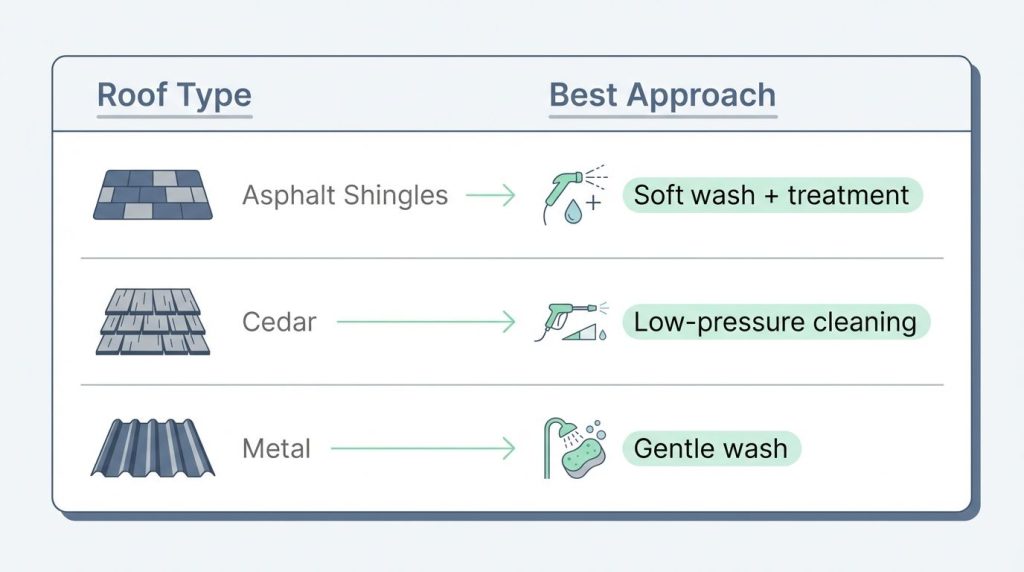
| Roof type | Usually best approach | Why |
|---|---|---|
| Asphalt shingles | Soft wash + treatment | Protects granules and edges while targeting spores and roots |
| Cedar (shakes/shingles) | Low-pressure cleaning + careful treatment | Avoids splintering and surface damage |
| Metal panels | Gentle wash, spot treatment where needed | Less moss risk, but seams and flashing need care |
Also, roof access is a big deal here. WorkSafeBC rules require fall protection when a fall of 3 m or more may occur, and steep roof work has extra requirements (for example, very steep slopes may require toe-holds and personal fall protection systems).
What is pressure washing, and why do roof companies warn against it on shingles?
Pressure washing uses high-pressure water to blast away grime, algae, and moss. Many electric units sold for home use sit in the 1700 to 2300 PSI range, and gas units can push higher.
That water pressure can be great on the right surface. On asphalt shingles, it’s where problems start, granule loss, lifted edges, and water pushed under the shingle courses.
That’s why shingle manufacturers keep repeating the same warning. CertainTeed says not to use a power washer on asphalt shingles because it can dislodge granules, and Owens Corning also warns against high-pressure power washing because it can loosen and remove granules.
- It’s fast for visible moss: the roof looks “clean” quickly.
- It can miss the root cause: spores and roots can survive and return.
- It can damage the roof system: especially older, brittle shingles.
If a contractor refuses to pressure wash your shingle roof, that’s usually a good sign.
What damage can high pressure cause on asphalt shingles (granule loss, lifted edges, leaks)?
Asphalt shingles are designed to shed water, not take a beating. High-pressure water can strip protective granules, and that can shorten the roof’s service life.
It can also lift shingle edges and force water where it does not belong, under laps, into nail lines, and around flashing details.
The big “why you should care” point is simple: once water gets under shingles, you may not see the damage right away. You might only notice it later, as staining, rot, or mould.
Owens Corning’s guidance is blunt: avoid high-pressure power washing because it can loosen and remove granules, which can shorten the life of the roof covering.
If your roof is older, already has curling edges, or has any soft spots in the decking, skip the pressure washer. The repair bill can easily cost more than a proper soft wash treatment.
Where pressure washing actually makes sense (concrete, some patios, some driveways, not roofs)?
Pressure washing shines on hard, durable exterior surfaces where you want to remove dirt, algae, grease, and embedded grime.
- Concrete driveways and sidewalks: great for algae slick, tire marks, and surface dirt.
- Some brick and stone: useful, as long as mortar and joints are sound.
- Some patios: especially textured concrete or pavers that can take the spray.
- House washing (select cases): many siding types do better with soft washing, but pressure washing can be appropriate with the right nozzle, distance, and pressure settings.
Solar panels are a clear “no” for pressure washing. Canadian Solar’s handling guidance lists a maximum recommended water pressure of 4 MPa (40 bar) and warns against high-pressure washer or jet washing systems, recommending gentle tools like soft cloths, sponges, or soft-bristle brushes instead.
Soft wash vs pressure wash: what’s the real difference in results and regrowth speed?
The short version is this: pressure wash removes what you see fast. Soft washing aims to kill what you don’t see, so you get slower return growth.
In Victoria, that difference matters because shade and moisture keep feeding moss. A method that only removes the top layer can look great for a bit, then you’re booking again sooner than you wanted.
| What you care about | Soft wash | Pressure wash |
|---|---|---|
| Risk to asphalt shingles | Lower (low-pressure rinse) | Higher (water force can lift edges and strip granules) |
| Visible results | Often improves over days to weeks after treatment | Immediate cosmetic change |
| Regrowth control | Better when treatment is included | Often faster regrowth if roots and spores remain |
| Best surfaces | Roof shingles, delicate home exterior areas | Concrete, some patios, some driveways |
If your goal is “clean today,” pressure washing wins. If your goal is “stay cleaner longer,” soft washing and pressure washing are not equal, the soft wash treatment is doing the heavy lifting.
Which method removes visible moss faster, and which one reduces return growth longer?
Pressure washing removes visible moss faster because it physically blasts it away.
Soft washing reduces return growth longer when it includes a real post-treatment. Local Victoria providers commonly describe moss-free windows in the 1 to 2 year range, depending on shade and surrounding trees.
- If your roof is fairly new and you care about warranty and lifespan, lean toward soft wash or pressure wash only where each one belongs, roof vs hard surfaces.
- If your roof is older or brittle, treat pressure washing as off-limits for shingles.
- If you want the longest gap between visits, ask what retreatment schedule the contractor recommends, and what’s included if moss returns inside the guarantee.
It’s normal for a chemical treatment to take time. You might see “ghosting” where moss was thick, then it lightens as weather and gentle rinsing do their part.
What’s safer for your roof warranty and roof lifespan in Victoria’s wet seasons?
If you want to protect your roof warranty and roof lifespan, the safest baseline is this: avoid high-pressure water on asphalt shingles.
That lines up with manufacturer guidance. CertainTeed warns against power washing asphalt shingles due to granule loss, and Owens Corning also warns against high-pressure power washing equipment for similar reasons.
- Pick a method that matches the material: shingles are not concrete.
- Ask what’s used for treatment: “we rinse it” is not the same as “we treat it.”
- Confirm how they prevent water intrusion: low-pressure rinse, controlled direction, and careful work around flashing.
- Don’t ignore safety: WorkSafeBC fall protection rules exist for a reason, especially on mossy, slippery roofs.
A pro-tip I always share is to treat moss control like maintenance, not an emergency. Once moss mats get thick, they hold water like a sponge and can stress shingles through freeze-thaw cycles and constant dampness.
What should a proper “soft wash roof cleaning” service include (step-by-step)?
A proper soft wash roof cleaning should look like a planned job, not a quick spray-and-go.
Here’s the step-by-step scope I like to see on Victoria roof quotes.
- Site walkaround and risk check: roof pitch, access points, and fragile areas like skylights and old vent boots.
- Protect plants and exterior surfaces: cover or pre-wet landscaping, and set up runoff control.
- Manual moss removal (as needed): de-bulk heavy moss in valleys, edges, and debris traps.
- Apply treatment evenly: focus on shaded slopes, valleys, and around roof penetrations.
- Low-pressure rinse (only if needed): enough to clear debris, not enough to drive water under shingles.
- Gutter and ground cleanup: clear gutters, flush downspouts, and remove debris from patios and walkways.
- Before-and-after documentation: photos help you see what changed and what still needs attention.
- Clear regrowth plan: what “moss-free” means, how long it lasts, and what retreatment looks like.
Owens Corning also calls out a practical detail many homeowners miss: cover vegetation below the roof and flush the roof and greenery with water after cleaning, since overspray and runoff can stress plants.
How do pros control runoff and protect gutters, landscaping, and downspouts?
Runoff control is where good roof cleaning looks different from sloppy roof cleaning. Pros don’t just “hope for the best.” They plan where the mix goes, and how it gets diluted and rinsed.
- Pre-wet and rinse plants: wet leaves help reduce chemical burn risk, then a final rinse clears residues.
- Use surfactants for cling: better dwell time can mean less overall runoff.
- Block and redirect flow: downspout control, temporary diverters, and targeted application reduce overspray.
- Finish with cleanup: gutters cleared, downspouts checked, debris removed from the ground.
This matters in Greater Victoria because local watersheds are sensitive to contamination. The Capital Regional District notes metals like copper and zinc as concerns in some creeks, and Environment and Climate Change Canada publishes aquatic-life protection guidance for metals like copper and zinc.
How much does soft wash vs pressure washing cost in Victoria, and what changes the price?
If you’re budgeting for roof moss removal in Victoria, you’ll usually see pricing described in a few ways: per square foot, minimum call-out, and add-ons like gutter cleaning. When considering roof moss services in Victoria BC, it’s important to understand the specific factors that can affect the final cost. Many service providers offer competitive packages that can include additional services, ensuring your roof is thoroughly maintained. Be sure to compare a few options to find the best deal that meets your needs.
As of 2025, Victoria-area pricing pages commonly list soft wash roof cleaning around $0.30 to $0.75 per square foot, with moss removal around $0.25 to $0.70 per square foot, depending on roof pitch, access, and severity.
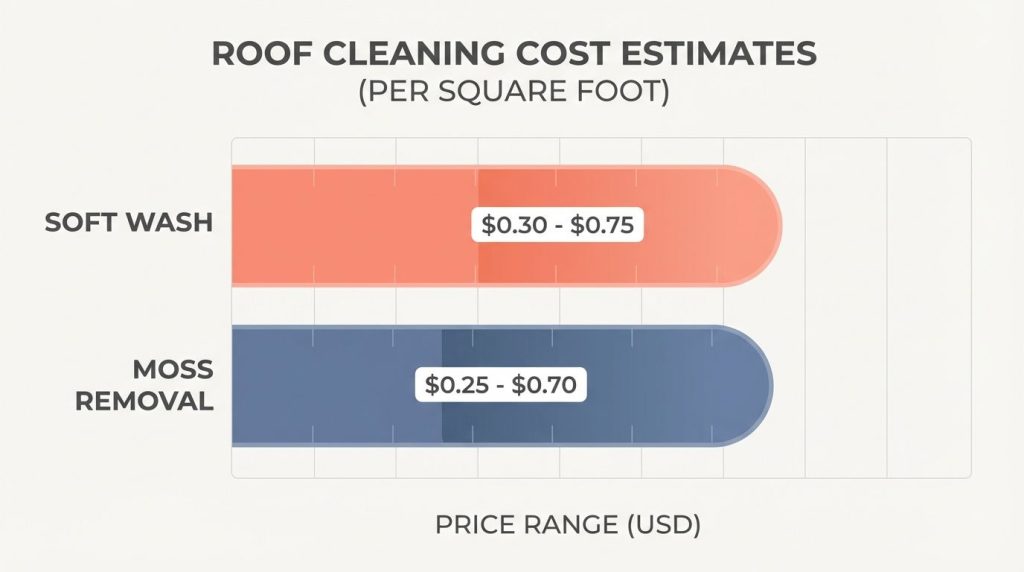
| Line item | How it’s often priced in Victoria | What to confirm in writing |
|---|---|---|
| Soft wash roof cleaning | $0.30 to $0.75 per sq ft | Does it include treatment, or just rinsing? |
| Moss removal (de-bulking) | $0.25 to $0.70 per sq ft | Hand removal in valleys and edges, plus cleanup? |
| Preventive retreatment | Often a flat add-on fee | What’s the retreatment schedule for shaded roofs? |
| Gutter cleaning | Add-on or per linear foot | Do they flush downspouts and remove debris from the ground? |
Roof size, steep pitch, extra storeys, and tricky access raise labour and safety costs. Heavy moss, fragile shingles, and lots of valleys also take longer, so the price rises.
If you like tracking home maintenance like an investment, keep your quote and scope notes together. A simple “project folder” mindset helps, the same way people track project investments.
Before you book, ask for a scope you can read in two minutes. If you can’t, ask for it again. And yes, you should still get a free quote from at least two providers so you can compare scope, not just price.
How to choose the right method for your home (quick decision checklist by roof condition + moss level)?
If you want a quick answer, start with roof material and roof condition. Then look at how established the moss is.
- Asphalt shingles (most Victoria homes): choose soft washing and pressure washing only where each belongs, soft wash for the roof, pressure wash for concrete.
- Old, brittle, or curling shingles: avoid high pressure and focus on low-pressure treatment.
- Light moss in a few shaded spots: treatment can sometimes do most of the work, with minimal de-bulking.
- Thick moss mats, especially in valleys: manual removal plus treatment is usually needed.
- Lots of tree cover: plan on more frequent retreatment, since debris and shade speed regrowth.
If you’re thinking about “extra protection,” ask a contractor about surface protection options and what they do well. In my own reviews, I’ve seen homeowners consider coatings like Vipeq Thermal CorkShield for exterior surfaces, and nano-style protectants marketed under names like Go Nano.
What to ask a contractor before you book (method, safety plan, after-treatment, re-growth expectations)?
A good contractor won’t dodge questions. They’ll welcome them, because clear expectations prevent problems later.
- Method: “Will you soft wash the roof, or will you use a pressure washer up there?”
- Products: “What cleaning solution do you use, and how do you protect plants?”
- After-treatment: “What do you apply for moss prevention, and how long does it usually last on a shaded roof?”
- Warranty details: “Is the moss-free guarantee 12 months or 24, and what counts as regrowth?”
- Safety: “Do you follow WorkSafeBC fall protection rules, and are you insured?”
- Cleanup: “Does your price include gutters, downspouts, and ground cleanup?”
Pressure washing FAQ (roof edition)
These quick answers can save you from the most common mistakes I see in Victoria.
- Can I pressure wash my asphalt shingle roof? Shingle manufacturers like CertainTeed and Owens Corning warn against power washing asphalt shingles because it can dislodge granules and shorten roof life.
- Is low-pressure the same as soft washing? Not always. Soft washing should include a treatment that kills growth, not just a gentle rinse.
- What about solar panels on the roof? Many manufacturers recommend gentle cleaning. Canadian Solar’s guidance lists a maximum water pressure of 4 MPa (40 bar) and warns against high-pressure washer or jet washing systems.
- Will moss come back? In Victoria’s wet climate, regrowth is normal over time. The goal is to slow it with treatment, cleanup, and a retreatment plan.
Conclusion: for roof moss in Victoria, which method is usually best, and what’s the next step to prevent regrowth?
For most Victoria shingle roofs, soft wash vs pressure wash isn’t a close call, soft washing is usually the safer choice for the roof itself.
Save pressure wash work for concrete, patios, and driveways, and use low pressure plus treatment for roof moss removal.
Your next best step is simple: book a proper soft washed treatment with clear cleanup and a retreatment plan, so moss has a harder time coming back.
FAQs
1. What are the differences between soft washing and pressure washing for moss removal on the home exterior?
Soft washing is a gentle washing technique that uses low water pressure and a cleaning mixture used in soft washing. Pressure washing uses high-pressure water to remove dirt and it has deep cleaning power. The differences between soft washing and pressure washing matter for roofs and fragile siding.
2. Which method is best for your home roof and house siding?
Soft washing is often the safest and most effective choice for Siding (construction), exterior finish and Paint. Pressure washing have their place on driveways and concrete, but it can damage fragile surfaces.
3. Can these methods effectively remove Mould, Mildew, stains, grease and grime?
Soft washing uses chemicals to break down and remove Mould and Mildew so it can effectively remove organic growth. Pressure washing can remove Stain and Grease (lubricant) with high force, but it may not stop regrowth. It cleans away dirt and grime, though it will not remove persistent grime.
4. Are chemical cleaners safe for the yard and the environment?
Many cleaners use Detergent or a Bleach based Chemical substance, and some are more Environmentally friendly with good Biodegradation. Ask for a low impact Cleaner and avoid heavy spray (liquid drop) near plants.
5. Do I need special gear or a pro to wash my home?
Yes, proper gear matters, like the right Nozzle and knowing the Pound per square inch, or psi, to use. Using a pressure washer without skill can hurt siding, so many people hire power washing services.
6. Will washing near gutters, windows or plants cause damage?
Washing near gutters or plants can cause harm if you use the wrong pressure or strong chemicals. Washing can cause loose paint to peel and washing can actually push water under shingles, so pick the right method for the exterior of your home.
Disclosure: This content is provided for informational purposes only. It is based on the expertise of local professionals with over 10 years of experience in roof moss removal in Victoria, BC. No affiliate or sponsorship arrangements apply.