
⚠️ PRO TIP: The “Granule Rule” (Read This First)
Do not let anyone pressure wash your asphalt roof.
Here is the fastest way to check if a previous job damaged your roof or if a quote you just received is dangerous. Look in your gutters.
Asphalt shingles are covered in tiny granules. These aren’t just for color; they protect the asphalt from UV rays and water intrusion (confirmed by major manufacturers like CertainTeed). If you see piles of grit that look like wet sand in your gutters or at the bottom of downspouts, your roof is dying.



Being a small business owner myself it’s hard to find committed employees to deliver the final process ❤️. Aneisha went out of her way to retrieve my daughter’s toy that was in the gutter. It did get damaged during the process but she went and got 2 replacements at her own expense. Wow my daughter was super happy. I offered her a cash tip for the extra request but she declined. Very polite and professional 😊.

Aneisha is a fabulous professional who communicated clearly what to expect and did a terrific job.

On time, clean, and considerate. Wonderful job

We just had all our windows cleaned yesterday but Gorilla Property Services. The two teams worked hard and a very professional job was the result. Our 22 unit strata has some challenging windows in amongst tree and shrubs. So all in all a fantastic job for the 2nd year. This company clean all siding and soffetts a couple years ago that make the place look like new. Mike

Joel and Francise very efficent

I just wanted to share how pleased I am with the service our building hired. The team was professional, arrived on time, and worked efficiently. They did a thorough job, Great experience overall—highly recommend!

Aneisha was quick, thorough and friendly

Booking: Toni was fantastic! Went out of his way to find us an appointment time as soon as he could even though they were quite busy on the days that worked best for us. Appointment Day: Aneisha and her team member showed up early, were polite and very friendly. They got to work right away after showing them our dryer vent outside. Aneisha even had me come outside to explain how it was going, what type of venting we had and how often we should be maintaining this type of cleaning. Thanks for the great service!! Would definitely recommend and use Gorilla Property Services again.

Aneisha and her work partner did a fantastic job at our building clearing the gutters and removing moss from our entryway. The before and after photos were striking with our gutters completely cleared. Highly recommend this company. We will be using their services again for sure. Thanks Toni, Aneisha and Francis for an excellent job!! Diane

Gorilla Property Services was a wonderful company to deal with. Toni was on top of all communication, servicing and on budget! Thank you Toni and Team for the great service!

Aneisha was great. She did a fantastic job, even vacuuming behind the dryer to make sure all the dust and lint was gone. Both she and her partner were very polite and friendly. We would gladly have their service again. Thank you.

I am a strata manager, and I have been using this company for the past 2 years and they are great! Toni is very attentive and always goes the extra mile for my clients.

Gorilla just completed their first visit to my strata for dryer vent cleaning, and I was very impressed with Aneisha, their lead technician. She double-checked the location of my dryer vent as the most obvious one has been inactive for years. She took the time to ask questions and locate the active vent, instead of walking away, which I very much appreciate. Thank you for being so thorough, friendly and respectful!

Aneisha and her partner came and cleaned our dryer vents today and did a great job. They were very friendly and professional.

Aneisha and Francis were great. They were fast and efficient and very friendly. They also cleaned up above and beyond. I will definitely be using them for future projects moving forward.

Toni and his team took care of us. Easy to deal with and honest with their assessment of what they could do. Cleaned our dryer vent with little supervision or direction. Added some compressed air treatment to the roof to address excess lint in addition. Thanks so much! Will definitely be requesting the service again next year. Cheers!

Toni was recommended by friends . He put lights high up on a weeping beech tree for me . He communicates well, is very prompt and honest . He is open to ideas and works efficiently. It was a great experience and the prices are reasonable . Thank you Toni !🎄

Just a quick shout out to Aneisha & her side kick who just left our place. They were punctual and friendly,appreciated the floor being covered for them and explained what they had done after they had completed the task. These 2 are keepers! Thanks for the great service:)

Brown bros contacted Gorilla gutter cleaning for the property. I am really impressed with the services. Aneesha and Will did a wonderful job and I will definitely recommend them.

Toni had us do some parking lot painting work. He was great to work with and very professional.

Aneisha and the other worker that came to Hotel Zed were fabulous. We were very impressed with the detail to getting the job done correctly!

Gorilla Property Services was contracted by our strata to perform a variety of services. All services was done professionally, timely, and above our satisfaction. Toni was always available to consult with me. We will definitely use them for all our future needs.

Aneisha did a wonderful job of cleaning our windows! So nice to have clean windows again

Toni and crew did a great job of cleaning our vinyl siding and washing our windows and deck glass. Toni is professional and personable, and a good communicator. Pricing was very reasonable too. It was a pleasure to work with the entire Gorilla team. Highly recommend!!

Amazing work and customer service! We recently got our roof and gutters cleaned and the difference is incredible - looks new again. Toni and his Gorilla team were so efficient, thorough and friendly - I will definitely be booking with Gorilla Property Services again! Highly recommend and will be in touch soon for power washing services. Thanks again :).

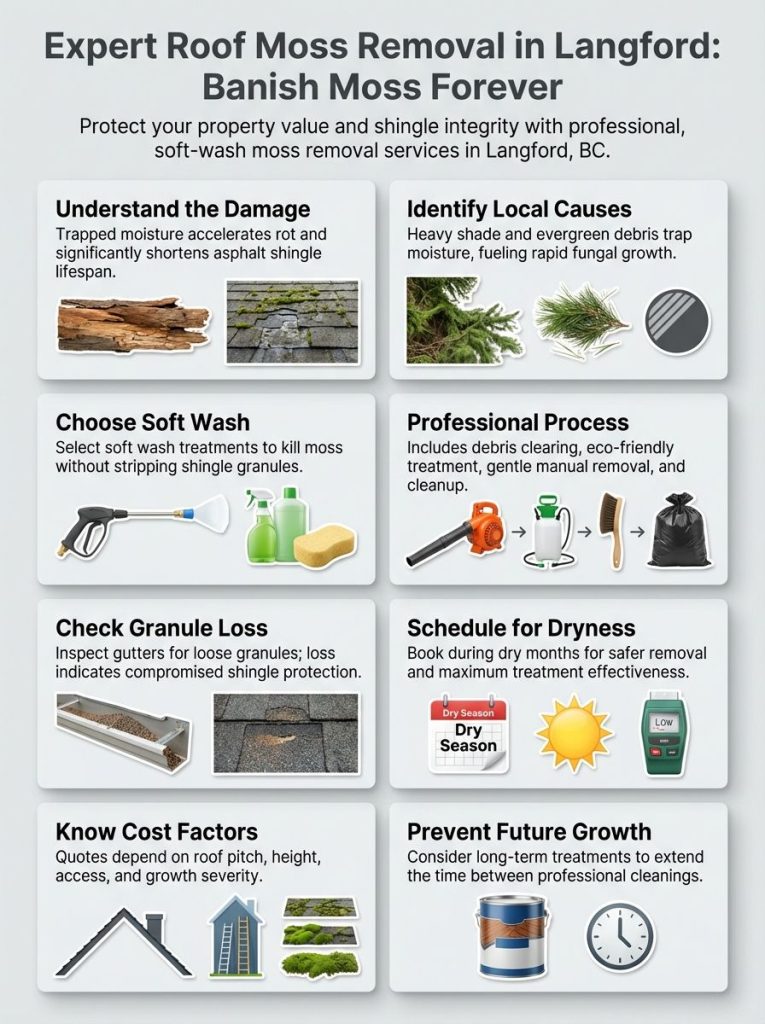
Aggressive cleaning strips these granules. Once they are gone, the sun eats the asphalt, the shingles curl, and you need a new roof usually within 2–3 years.
The Golden Rule: If a contractor relies on high pressure to blast moss off, they are blasting your warranty off with it.
The Reality of Roofs in the Westshore
I’m Victoria with Lipco Ltd. I’ve seen enough roofs in Langford to know that the “Goldstream Green” isn’t just a park; it’s what happens to your shingles if you ignore them.
You live in a wet coastal climate — and shaded roofs stay damp for long stretches. Langford, specifically areas like Bear Mountain and Happy Valley, sits in a unique microclimate. You get the heavy shade from Douglas Firs and the moisture retention from the valley geography.
Moss isn’t just a cosmetic issue here. It is a structural threat.
Find out the price for roof moss removal in Oak Bay, BC.
This guide cuts the fluff. I will explain exactly why moss damage to homes in Langford occurs, how to remove it without destroying the shingles, and what it actually costs in 2026.
Why Moss Kills Shingles (The Science)
Moss is deceptive. It looks soft, but it acts like a crowbar. If you are still skeptical, read our deep dive on does moss damage shingles?
1. The Sponge Effect
Moss doesn’t have true roots, but it anchors itself into the grit of your shingles. Its primary function is to soak up water. Some mosses (like sphagnum) can hold ~16–26x their dry weight in water; on roofs, moss traps moisture against shingles.
- Result: Your roof, which is designed to shed water, is now holding wet sponges against the asphalt 24/7.
2. The Freeze-Thaw Cycle
This is the real killer in BC. We don’t get -40°C, but we get frequent dips below zero (Environment Canada data shows Victoria hits -8.8°C extremes).
- The Mechanism: The wet moss freezes. Water expands when it turns to ice. This expansion pushes against the shingle tabs and lifts them.
- The Damage: Every winter, the moss literally pries your roof apart, millimeters at a time. This breaks the sealant strips and allows wind-driven rain to get underneath.
3. Acidic Erosion
Lichen (the flat, crusty growth) produces organic acids. These acids can etch mineral surfaces; combined with trapped moisture, it can contribute to stubborn staining and surface roughness over time.
The Method: Soft Wash vs. Pressure Wash
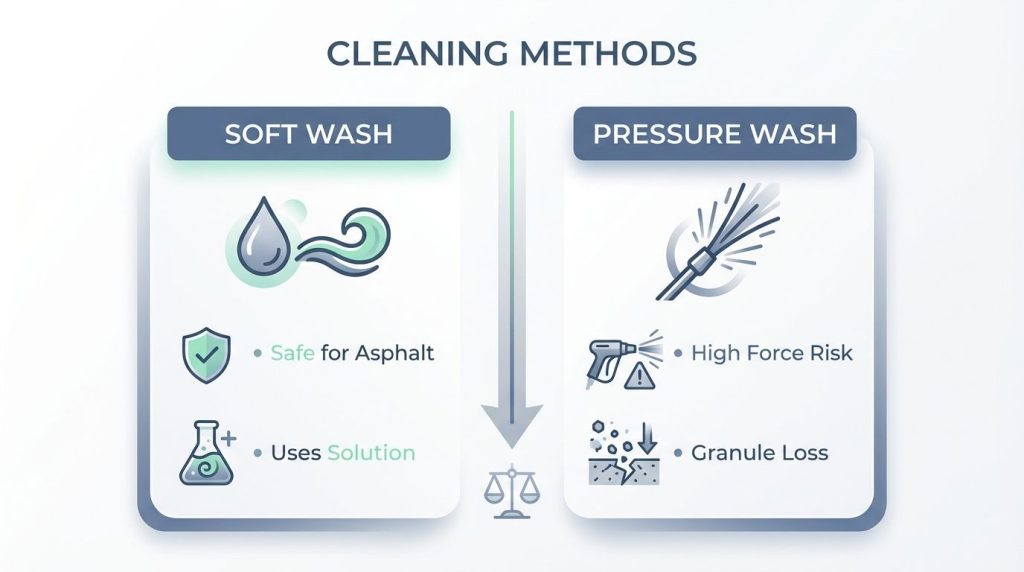
This is the most repetitive debate in the industry, so let’s settle it once and for all. You need to know the difference between soft wash vs. pressure washing before you hire anyone.
Pressure Washing (The Wrong Way)
- Mechanism: Uses 2,000+ PSI to blast organic matter off the surface.
- Why it fails: It shears the moss off but leaves the “roots” (rhizoids) embedded. It also blasts away the protective granules (see the Granule Rule above).
- Industry Stance: The Asphalt Roofing Manufacturers Association (ARMA) explicitly advises against pressure washing asphalt shingles.
Soft Washing (The Right Way)
- Mechanism: Uses low pressure (garden-hose level) and specialized chemistry.
- Why it works: We apply a solution that kills the moss, lichen, and Gloeocapsa magma (the black algae streaks) down to the root.
- The Process:
- Kill: The solution is applied and dwells for 20 minutes.
- Decay: The moss turns white/yellow (dies).
- Release: The roots release their grip on the shingle.
- Rinse: We rinse it away gently, or in some cases, let the rain naturally wash the dead organic matter down over 4-6 weeks (Nature’s Rinse).
Comparison: Methods at a Glance
| Feature | Soft Wash | Pressure Wash |
|---|---|---|
| Pressure Level | Garden-hose level | 2,000 – 4,000 PSI |
| Granule Loss | Minimal / None | High / Severe |
| Root Kill | 100% (Chemical penetration) | 0% (Shears off top only) |
| Regrowth Speed | Slow (1-3 Years) | Fast (6 Months) |
| Warranty Safe | Yes | No |
There is a massive difference between simple blowing vs deep cleaning. See our comparison on moss removal vs. roof cleaning to understand which service you actually need.
The Lipco Protocol: What You Are Paying For
When you hire a professional in Langford, you aren’t paying for a guy with a ladder. You are paying for a system that prevents damage. Here is exactly what’s included in our roof moss removal.
Phase 1: Preparation & Safety
- Site Protection: We water down your plants before, during, and after. We bag downspouts to catch runoff so sludge doesn’t enter your perimeter drains.
- Fall Protection: This is non-negotiable. WorkSafeBC regulations change once a roof pitch exceeds 4:12. We use harnesses and anchors. Always get a WorkSafeBC clearance letter; otherwise you could be jointly liable for unpaid premiums.
Phase 2: De-Bulking
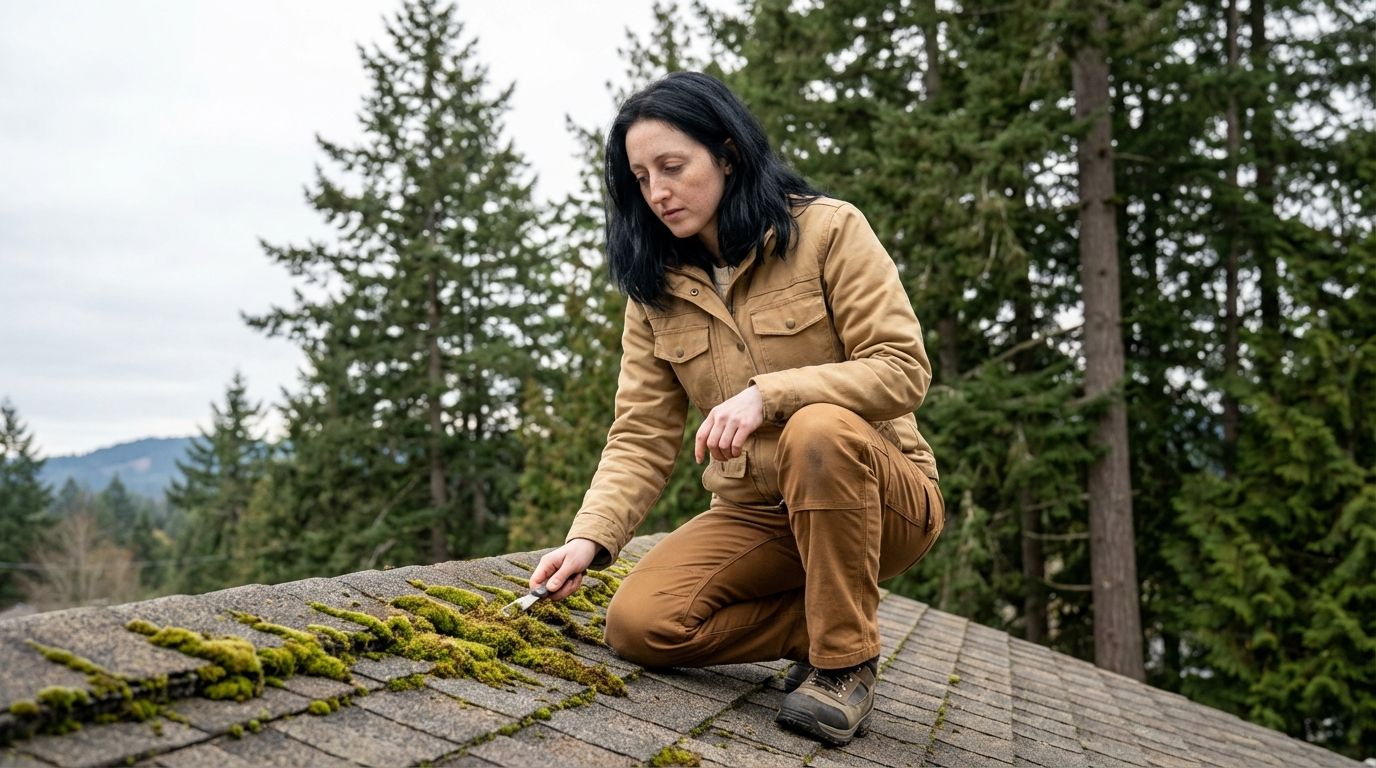
- Manual Removal: If the moss is thick (carpet-like), we don’t just spray it. We gently brush it off using soft-bristle brushes.
- Why? You cannot spray chemical through 2 inches of moss. You have to remove the bulk to expose the roots.
Phase 3: The Treatment
- Application: We apply the treatment solution. This kills the remaining spores and algae hidden in the cracks.
- The Wait: The solution needs dwell time. This isn’t a “spray and go.” It needs to soak.
Phase 4: The Clean Up
- Gutter Flush: All that moss ends up in the gutter. We clean the gutters and flush the downspouts to ensure flow.
- Perimeter Check: We walk the grounds and clean up any debris that fell.

Cost Breakdown (2026 Market Rates)
Pricing in Victoria and Langford is often opaque. Let’s fix that. In 2026, legitimate companies typically charge between $0.20 and $0.70 per square foot. Read more about moss removal in Sidney, BC:
Why the huge gap? It’s not arbitrary. It comes down to four factors.
The 4 Factors That Spike Your Quote
- Pitch (Steepness)
- Walkable (4:12 – 6:12): Cheaper. Crew can walk safely.
- Steep (8:12+): Expensive. Requires rope access technicians and slower movement.
- Moss Density
- Light Algae: fast spray application. Lower end of the price.
- Heavy Carpet: Requires manual de-bulking before treatment. Double the labor.
- Access
- Is your house on a cliff in Bear Mountain? Can we get ladders up? Do we need a boom lift?
- Roof Material
- Asphalt is standard. Concrete tile or cedar shake requires different protocols and chemicals.
Estimated Cost Table (Average 2,000 sq ft Home)
| Service Level | Description | Price Range (Est.) |
|---|---|---|
| Basic Prevention | Light spray for algae/black streaks. No moss chunks. | $400 – $600 |
| Standard Removal | Moderate moss. Manual brush + Treatment + Gutter Clean. | $600 – $900 |
| Heavy Restoration | Thick growth. Heavy brushing + Heavy Treatment + cleanup. | $900 – $1,400+ |
Note: You may see ads for free roof moss removal in Victoria, but these are usually limited seasonal promotions. Quality chemistry costs money.
Timing: The “Dry Window” Strategy
You can’t clean a roof in a rainstorm. The chemical will dilute and wash away before it kills the roots. Choosing the best time of year to remove moss is key to longevity.
Easiest & Safest: July & August. Why: The moss is dry and brittle. It flakes off easily. The roof is hot, so the chemical reacts faster.
Acceptable: April – June, September – October. Conditions: We need a window of 24 hours without heavy rain after application for the treatment to bond.
Worst Month: November – February. Why: It’s too wet. Slipping hazards are extreme. We can do emergency manual removal, but chemical treatments are less effective.
DIY vs. Professional: A Reality Check
I am an editor for a renovation company, so you expect me to say “hire us.” But I respect the DIY spirit. If you want to do this yourself, read our guide on how to remove moss from your roof first.
Can you do it? Yes, if your roof is low pitch (walkable) and you have the right gear.
The Risks:
- The Fall: Falls from roofs are a leading cause of injury in BC residential construction.
- The Burn: Professional soft wash chemicals are strong oxidizers. They will bleach your clothes and burn your skin if mishandled. They will kill your wife’s prize hydrangeas if not managed correctly.
- The Pressure Washer: We already discussed this. One slip with a high-pressure wand and you have sliced a shingle in half.
My Verdict: Clean your own gutters? Absolutely. Apply specialized chemicals on a pitched roof 20 feet in the air? Pay the $600. It is cheaper than an ER visit. If you do go DIY, research the best moss killer for roofs or the best roof moss removal spray before buying generic bleach.
Prevention: Stop It Before It Starts
Once we get your roof clean, keep it that way.
- Trim the Firs: If a branch is hanging over your roof, cut it. Shade + dropped needles = Moss Factory.
- Zinc Strips: Installing zinc strips at the ridge can help. As rain hits the zinc, it releases ions that inhibit growth. They aren’t a cure-all, but they help.
- Advanced Protection: For older roofs, we sometimes look at treatments like GoNano in Victoria to modify the surface and improve drainage.
- Keep Valleys Clear: Use a leaf blower (safely) to keep pine needles out of the roof valleys. Debris dams hold water.
Frequently Asked Questions (No Fluff)
1. Will the chemical kill my plants? It can if the contractor is lazy. A pro team saturates the soil with water before starting. This prevents the roots from absorbing any runoff chemical. We also cover sensitive landscaping.
2. How long does the treatment last? In Langford’s shade? Expect 2 to 3 years. If you have full sun, maybe 4 to 5 years. There is no such thing as “permanent” removal in a rainforest.
3. Why do I see white stuff on my roof after you leave? That is the dead moss. It turns white or yellow when it dies. We brush off the bulk, but we leave the roots to desiccate and fall off naturally. Trying to scrape every tiny spec immediately causes too much damage to the shingle.
4. My insurance company sent me a letter about my roof. Can you help? Yes. Insurance companies are cracking down. They use drones and satellite imagery. If they see moss, they threaten cancellation. We provide a receipt and photos of the clean roof that you can send to your broker to satisfy their requirements.
5. Do you serve Sooke and Sidney? Yes. The climate is the same, the moss is the same, and our trucks drive there. Check our blog for more local tips.
Ready to stop the rot? Don’t wait until the shingles lift. Contact Lipco Ltd for a Quote or visit our Contact Us page.