
Author: Victoria Lano, Lipco Ltd. Region: Greater Victoria & Coastal BC Reading Time: 8 Minutes
⚠️ CRITICAL WARNING: Read This Before You Buy Anything
Do not pressure wash asphalt shingles.
Before we talk about sprays, you need to know what kills a roof faster than moss: high-pressure water.
If you blast asphalt shingles with a pressure washer, you strip the protective granules that block UV rays. Once those granules are gone, your shingles dry out, curl, and fail years early.
This isn’t just my opinion. Major manufacturers like Owens Corning and GAF explicitly warn against this. Even the Asphalt Roofing Manufacturers Association (ARMA) advises that high-pressure washing can damage your roof system.
If you are looking for a spray because you want to avoid pressure washing, you are already on the right track.
The Hard Truth About “Magic” Sprays
Is roof moss removal starting to feel like a never-ending Victoria or Langford chore? You likely want a bottle you can hook up to a hose, spray once, and watch the moss vanish.
Here is the reality of our wet climate: Sprays work on roots and spores. They rarely dissolve thick, carpet-like moss on their own.
If you have two inches of green sponge growing on your roof, spraying it is a waste of money. The chemical kills the top layer, but the dead moss acts like a sponge, holding moisture against the shingle and rotting the wood deck underneath.
The Winning Formula:
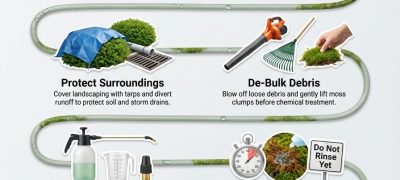
- Manual Removal: Get the bulk off first.
- Chemical Treatment: Kill the spores and roots the broom missed.
- Prevention: Keep it from coming back next winter.
I work with Lipco Ltd, a family-owned renovation company in Greater Victoria. After 10+ years around local roofs, I can tell you that the “best” spray isn’t the strongest chemical—it’s the one that fits your specific roof type and your patience level.
Part 1: Choosing Your Chemistry (The 3 Main Types)
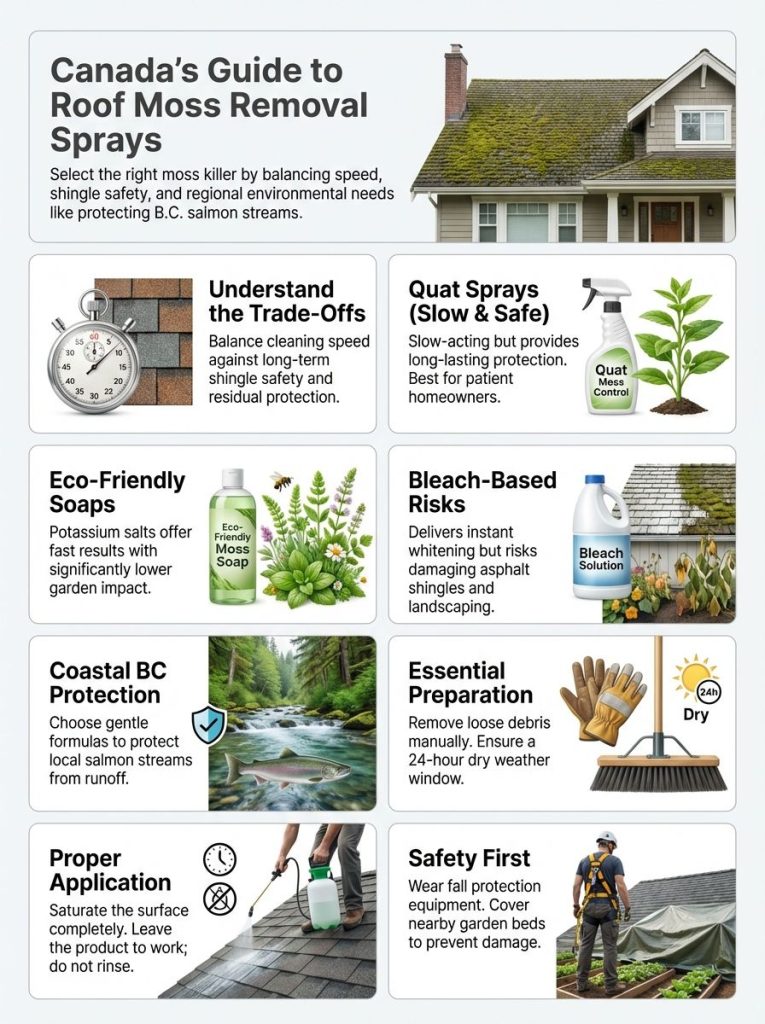
You don’t need to be a chemist, but you do need to know what you are putting on your house. When looking for the best moss killer for roofs, most products in Canada fall into three buckets.
1. Quaternary Ammonium (“Quats”)
- Best for: Asphalt shingles, long-term prevention, and patience.
- Popular Brands: Wet & Forget, 30 Seconds Spray & Walk Away.
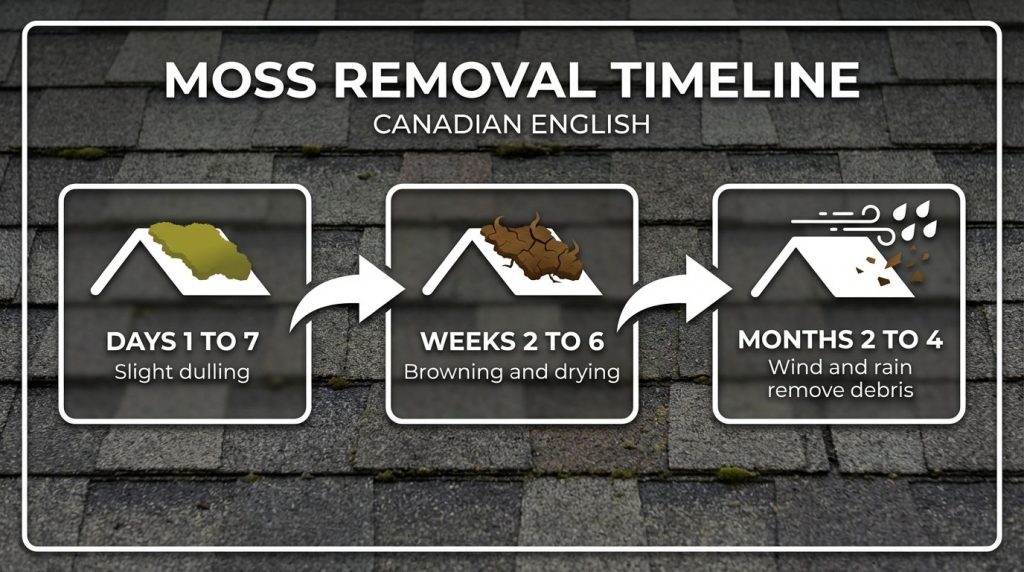
- How it works: You spray it on dry moss. The active ingredient (often alkyl dimethylbenzylammonium chloride) disrupts the cell walls of the spores. Over the next 3 to 6 months, rain reactivates the residue, slowly washing the decay away.
- The Trade-off: It is slow. You will spray it and see zero difference for weeks. Do not panic. It works, but it plays the long game. This is the safest option for asphalt shingles because it requires zero scrubbing.
2. Potassium Salts (Soap-Based)
- Best for: Roofs near sensitive gardens, patios, or fish ponds.
- How it works: These are essentially strong soaps (fatty acids) that dry out the moss quickly.
- The Trade-off: They don’t leave a long-lasting “kill zone” like quats do. You get a faster visual result (browning), but the moss might return sooner.
- Note: Health Canada registrations change frequently. Always check the label for a valid PCP (Pest Control Product) number. You can verify product status via the PMRA database.
3. Bleach-Based Oxidizers (Sodium Hypochlorite)
- Best for: stubborn black algae stains (Gloeocapsa magma) or when you are selling the house next week.
- How it works: Instant chemical reaction. It turns organics white/clear almost immediately.
- The Trade-off: It is risky. Health Canada warns against mixing bleach with other cleaners (like ammonia or acids) as it creates toxic gases. It can also rust metal flashings and kill landscaping instantly if runoff isn’t managed.
- My Advice: Treat this as a specialized tool, not a maintenance staple. If you use it, you must rinse thoroughly, which introduces water management issues.
Part 2: The Manual Removal Protocol (Do This First)
If you have visible clumps of moss, stop shopping for sprays and go get a ladder. For a detailed breakdown of the technique, check out our guide on how to remove moss from your roof.
The “Gentle Agitation” Method:
- Dry Conditions: Never walk on a wet, mossy roof. It is essentially an ice rink. Wait for a dry day.
- The Tool: Use a soft-bristle broom or a plastic leaf rake. Never use a wire brush on asphalt shingles; wire brushes rip granules off.
- The Direction: Always brush down the slope (from ridge to eave). If you brush upward, you risk lifting the shingle tabs and breaking the sealant strip.
- Debris Management: Bag the moss as you go. If you let it wash into your gutters, you will have a clog and an overflow problem in the next rainstorm.
Once the “carpet” is gone, you are left with a thin layer of organic fuzz and spores. Now you are ready to spray.

Part 3: Application Timing (The “Dry Window” Rule)
Living in Victoria means dodging rain. The most common reason sprays “fail” is because they were applied right before a drizzle. Knowing the best time of year to remove moss is half the battle.
The “Quat” Rule of Thumb: You generally need a solid dry window after application. The liquid needs to soak into the moss and dry onto the surface.
- Wet & Forget: Typically asks for no rain expected for 4–5 hours.
- 30 Seconds Spray & Walk Away: Suggests that no rain be predicted for 12 hours+ for maximum effect.
The Temperature Factor: Do not spray if it is freezing. If the liquid freezes on the roof, it expands and can damage the shingle. Conversely, on a scorching July day, the spray might evaporate before it soaks into the moss. Aim for an overcast morning, roughly 10°C to 20°C.
Part 4: Runoff & The Environment (Victoria Reality Check)
In Greater Victoria, our storm drains often lead directly to creeks and the ocean. We have to be smarter about runoff than someone in a landlocked, dry city.
Copper and Zinc are often marketed as “moss killers” (powders or metal strips). While effective, they work by leaching heavy metals into the water runoff. BC water quality guidelines indicate that copper can be harmful to marine life even at low levels.
How to Protect Your Property & Watershed:
- Disconnect Downspouts: If possible, temporarily divert your downspout into a gravel bed or a bucket during the first heavy rain after treatment. Don’t let the first “flush” of chemicals go straight into the storm drain.
- Tarp the Perimeter: If you are using a bleach-based or caustic cleaner, tarp your azaleas and rhododendrons. Pre-wet the plants with fresh water before you spray the roof; this dilutes any chemical drift that lands on them.
- Use Less Product: Spot treat. You rarely need to coat the entire roof edge-to-edge. Focus on the north-facing slopes and shaded valleys where the moss actually lives.
Part 5: Regional Differences (Why Victoria is Different)
Canada is four different “roof climates” in a trench coat. Advice from a forum in Winnipeg or Toronto often fails here.
Coastal BC (Victoria/Vancouver):
- The Enemy: Constant moisture, massive trees, shade.
- The Strategy: We deal with heavy green moss, not just black streaks. We need physical removal + residual chemical prevention (Quats).
- Rainfall: Victoria sees around 900mm of rain annually. This washes sprays away faster than in the interior. You might need to re-apply preventative sprays once a year, rather than every 3 years.
The Prairies (Winnipeg/Regina):
- The Enemy: Snow and ice, dry summers.
- The Strategy: Moss is rare. Usually, spot treatment is enough.
Ontario/Quebec:
- The Enemy: Black algae streaks (Gloeocapsa magma) and humidity.
- The Strategy: Aesthetics are the main driver. Bleach-based washes are more common here to “brighten” the roof for curb appeal.
Part 6: When to Call a Pro
There is no shame in admitting a roof is too steep or too high.
The 10-Foot Rule: WorkSafeBC regulations require fall protection for heights over 3 meters (10 feet). If your roof is steep (anything over a 6/12 pitch) or two stories up, the risk of a fall outweighs the money you save doing it yourself.
Professional Soft Wash: If you hire a company, ensure they offer “Soft Washing.” This uses a dedicated low-pressure pump (like a glorified agricultural sprayer) to apply cleaning solutions. If you see a contractor pull up with a high-pressure wand and start blasting, fire them on the spot.
For trusted local advice and a free roof cleaning quote, check out roofmossremovalvictoria.ca.
FAQ: Clearing Up the Confusion
Q: Will sprays remove moss instantly? A: Usually no. Wet & Forget notes results often take 2-3 months, sometimes longer. 30 SECONDS suggests it takes 1-4 weeks for visible results.
Q: Can I pressure wash moss off asphalt shingles? A: Absolutely not. Manufacturers like GAF and Owens Corning warn against it because it dislodges protective granules and shortens roof life. Read more about Soft Wash vs Pressure Washing.
Q: How long does it need to stay dry after I apply? A: It varies by product. Wet & Forget usually asks for 4–5 hours, while 30 SECONDS Spray & Walk Away typically requires 12 hours+ without rain.
Q: Is bleach safe to use on a roof? A: It can work for staining, but it carries higher risks for plants and metals. Health Canada advises you never mix bleach with other cleaners (ammonia/acids) due to toxic gas risks.
Q: When should I call a pro instead of spraying? A: If the roof is steep or the moss is thick like carpet. Manual removal is safer for the roof in those cases. Also, remember that fall risk is real—WorkSafeBC sets strict safety standards for a reason.
Summary: The “best” spray for Victoria isn’t a magic eraser. It is a tool you use after you broom off the heavy growth. Prioritize products that offer residual protection (Quats), respect the “no pressure wash” rule, and watch your weather window carefully.
Disclosure: The views expressed are based on over 10 years of local experience with Lipco Ltd. Data and guidelines are based on local weather patterns, WorkSafeBC, Health Canada, and Environment and Climate Change Canada.