
Ever looked up after a rainy week in Victoria and thought, “How did my roof get so green so fast?” Roof moss removal can feel like a never-ending chore here, especially on asphalt shingles.
I’m Victoria, and after more than 10 years around renovation and maintenance work, I’ve learned that the “easy fix” usually means the moss comes back, sometimes worse.
So let’s make removing moss simple, safe, and long-lasting.
Why does roof moss grow so aggressively in Victoria-style wet climates, and why “easy fixes” often fail?
Greater Victoria gets a long stretch of cool, damp weather that moss loves. Environment and Climate Change Canada’s 1991 to 2020 climate normals for Victoria list about 675 mm of precipitation a year, with the wettest stretch typically in late fall and winter.
That moisture matters because moss does not just sit on the surface. It anchors into gritty shingle texture, then holds water like a sponge.
In real life, I see moss grow fastest in the same repeat spots:
- North-facing slopes that stay damp and shaded.
- Roof valleys where needles, leaves, and dirt settle and stay wet.
- Behind chimneys and vents where the sun hits less and moisture lingers.
- Roof edges under overflowing gutters where splash-back keeps shingles wet.
Those quick blow-offs and rinse-only cleanups fail because they remove the “fluffy” top, but leave root threads and spores behind. A light sweep can also roll granules off your roof shingles, which shortens shingle life.
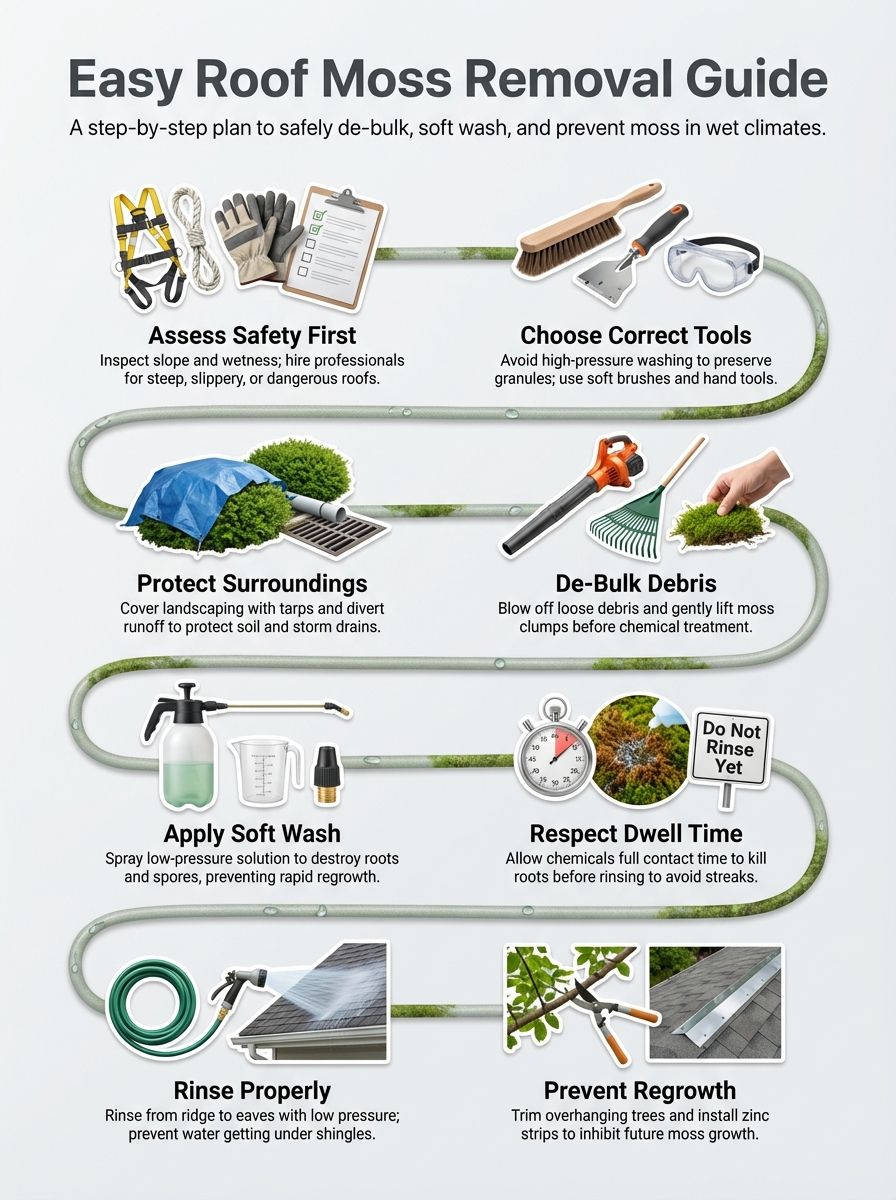
For effective roof moss removal in Victoria, you want a three-part plan: de-bulk first, then a soft wash that targets roots, then debris control so the roof surface can dry out.
How do you tell if your roof is safe to work on, or if it’s a “call a pro” situation?
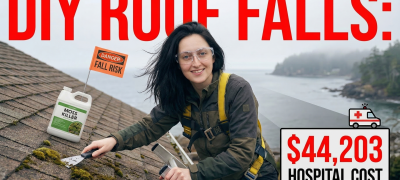
Moss on roof shingles is slippery, and wet shingles can be dangerous even when the pitch looks “not that steep” from the ground.
If you want a clear rule, WorkSafeBC’s regulation requires fall protection when a fall of 3 m (10 ft) or more may occur, and it also flags lower heights where the risk is higher than a flat surface (like falling onto stairs, a curb, rocks, or a fence).
Here’s my simple “call a pro” checklist for Victoria, BC homeowners:
- You have a steep roof, or you feel unsure standing on a ladder near the eaves.
- Your roof is wet, or the moss is thick enough to feel spongy underfoot.
- You see cracked, curled, or loose shingles, or soft spots that could be rot.
- You need to work near a valley, skylight, chimney, or edge, where slips and missteps happen fast.
- You have cedar shakes that are older or brittle, since walking can crack them.
If you hire someone, ask two things before they start: how they handle fall protection, and how they manage runoff so it does not pour into gutters, downspouts, landscaping, and storm drains.
Roof Safety Checklist
- Confirm the roof is dry and stable before working.
- Verify the ladder is secure and placed on firm ground.
- Ensure proper fall protection is in position.
- Check that all tools and equipment are in good condition.
What tools actually help remove moss without destroying shingles (and what tools ruin roofs)?
The goal is to remove moss from a roof without scraping away the protective surface. On asphalt shingles, that means you protect the granules. On cedar and tile, it means you protect the surface fibres and edges.
Tools that help (and why):
- Leaf blower: perfect for dry de-bulking, especially needles and loose moss.
- Soft-bristle brush: lifts remaining moss gently without gouging the shingle.
- Plastic scraper: safer than metal when you need to lift stubborn clumps.
- Garden sprayer or soft-wash equipment: applies moss killer evenly without blasting water under shingles.
Tools that ruin roofs:
- Pressure washing: strips granules and can force water under shingles.
- Wire brushes and metal scrapers: chew up asphalt shingles and leave the roof rougher, which helps moss appear again sooner.
- Abrasive “power broom” attachments: they can shred shingle edges and thin out granule coverage.
If you want the roof to stay clean longer, pair gentle removal with a treatment that kills moss roots and spores. Brushing alone usually will not remove the whole problem.
Why pressure washing is the fastest way to strip granules and shorten roof life
Pressure washing “works” fast because it blasts material off the roof. The problem is, it blasts off the wrong material too.
When you strip granules from asphalt shingles, you expose more of the asphalt and bitumen layer to sun and weather. That can speed up aging and raise leak risk.
If a cleaner promises “instant results” by pressure washing a moss-covered roof, treat that as a red flag. Speed is not worth a shorter roof life.
If your roof has already been pressure washed, keep an eye out over the next few rains for lifted shingle edges, granules collecting in gutters, and new damp spots in the attic or ceiling.
Step 1: How do you de-bulk moss safely (blow-off + gentle lift) before any treatment?
De-bulking means removing the bulk clumps so your treatment can reach the roots and remaining moss. This is where most DIY moss jobs either go great, or go sideways.
Here’s the safest way to do it when the roof is dry and calm, with no gusty wind:
- Start from the ground: use binoculars and look for valleys, chimney backs, and shaded edges.
- Set a tarp below: it catches moss and keeps it out of soil and garden beds.
- Blow off loose debris first: aim down-slope so you do not lift shingle edges.
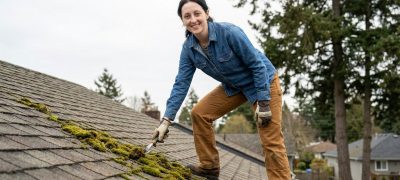
- Gently lift clumps: use a soft brush or plastic scraper, working with the shingle direction.
- Clean roof valleys carefully: valleys collect debris, but they are also high-risk slip zones.
My biggest practical tip: do not chase perfection at this stage. You are not trying to “detail clean” the shingle roof. You’re making space so the treatment can do its job.
Step 2: What is “soft washing” and how does it kill moss roots/spores instead of just removing clumps?
Soft washing is low-pressure application of a roof-safe chemical substance that kills moss growth, algae and moss spores after you’ve removed the thick clumps.
In Greater Victoria, you’ll hear a few approaches described as “soft wash,” and they are not all the same.
If you’re comparing options, this quick table helps you ask better questions:
| Approach | What it does well | Common downside |
|---|---|---|
| Manual removal only | Immediate cleanup of thick moss | Moss roots and spores often survive, so regrowth is fast |
| Soft wash treatment (low pressure) | Kills remaining moss, algae, and spores to slow regrowth | Requires careful runoff control and correct application |
| Pressure washing | Looks fast | Can strip granules, force water under shingles, and shorten roof life |
One more real-world detail: soft washing only works if you apply it evenly. Miss a shaded valley or the back of a chimney, and you will be back up there sooner than you want.
What dwell time means, and how you avoid streaky “half-clean” results
Dwell time is the time the treatment stays wet on the roof so it can penetrate and kill what’s attached to the roof surface.
If you rush this part, you often get a streaky roof where some patches die and others stay green. That is usually not a “bad product,” it is uneven coverage or not enough dwell time.
If you use a retail product, always follow label directions.
- Work in sections so you do not miss shaded areas.
- Keep your spray pattern consistent, and overlap slightly like you would when painting.
- Do not “spot spray” only the green parts, because spores spread beyond what you see.
Which roof surfaces need different chemistry (asphalt vs cedar vs tile vs metal)?
This is where a lot of DIY moss removal goes wrong. People use one “moss killer” recipe for everything, then wonder why the roof looks patchy, or why the plants look stressed afterwards.
Think of it this way: the same treatment that is gentle on tile might be too harsh on cedar. The same technique that looks fine on metal can be risky on asphalt shingles.
Use this as a practical starting point:
| Roofing material | What to prioritize | What to avoid |
|---|---|---|
| Asphalt shingles | Protect granules, keep water flowing down-slope, use low-pressure treatment | Pressure washing, wire brushes, aggressive scraping |
| Cedar shakes | Gentle cleaning so the wood can breathe, avoid cracking brittle shakes | Walking on older shakes, high oxidation chemicals that grey the surface |
| Tile | Clean without breaking edges, keep valleys clear | Stepping on weak points, blasting water under tiles |
| Metal roof | Control runoff, avoid scratching coatings, rinse down-slope | Abrasive pads, harsh chemicals that can stain finishes |
If you’re trying to kill roof moss and keep it from coming back, match the chemistry to the material, then match the rinse approach to the roof design.
What’s safer for cedar when you don’t want harsh oxidation effects
Cedar needs a gentler approach because it can oxidize, grey, or lose surface fibres if the chemistry is too aggressive.
The Cedar Shake & Shingle Bureau also points out something homeowners miss: cedar needs to breathe, so packed-in needles and debris shorten lifespan. That’s why cedar roof care is as much about debris control as it is about removing moss.
For prevention, they note that zinc or copper strips at the ridge can help control moss for a limited run down the roof (they describe it as only a few feet of coverage).
If you want an eco-friendlier option, I also keep an eye on protective coatings like GoNano and Vipeq Thermall Corksheild in the right situations, especially when the goal is longer-term moss prevention on wood surfaces like roofs and decks.
How do you protect gutters, downspouts, and landscaping from moss-treatment runoff?
Runoff is not a side detail. In Victoria, BC, roof drainage often flows straight into planted beds, rain gutters, and downspouts, then out to the storm system.
Here’s a simple protection setup that works well for many homes:
- Pre-soak plants and soil with clean water so they are less likely to absorb treatment.
- Cover sensitive shrubs with plastic sheeting (and remove it as soon as you’re done so plants do not cook in the sun).
- Use weighted tarps below drip lines to catch moss and drips.
- Control the downspouts: route them into a bucket, or use temporary tubing to divert flow away from garden beds.
- Plan your cleanup: rinse patios, siding, and walkways after treatment so residue does not dry and spot.
If you hire a contractor, ask for a written runoff plan and confirm they clean gutters and flush downspouts as part of the scope.
What’s the correct rinse approach (top-down, low pressure) so you don’t force water under shingles?
Rinsing is where you can accidentally create leaks. Your roof is designed to shed water down the roof plane, not take water pushed up under the shingle laps.
Use a top-down approach:
- Start at the ridge and rinse toward the eaves.
- Aim down-slope, never up-slope.
- Use low pressure (garden hose pressure or a proper soft-wash rinse).
- Use a wide fan spray so the water “sweeps” instead of blasts.
If you notice water getting behind flashing, under shingle edges, or into attic vents, stop and reassess. That’s a sign the rinse direction or pressure is wrong.
This is one reason many homeowners prefer soft washing with careful application over heavy rinsing. You can get rid of moss on roof surfaces without turning your roof into a water intrusion test.
What are the most common DIY mistakes that create leaks, granule loss, or slippery fall risk?
If I could save you from just one headache, it would be this: most DIY moss problems are not caused by “bad effort.” They’re caused by one or two avoidable decisions.
Here are the mistakes I see most often in moss on a roof situations:
- Using a pressure washer and stripping granules off asphalt shingles.
- Scrubbing with wire brushes or metal scrapers, which gouge the shingle surface.
- Aiming water up the roof, forcing water under shingles and into vulnerable spots.
- Climbing a wet, mossy roof without proper fall protection and footwear.
- Relying on vinegar, dishwashing liquid, or random soap mixes, which can leave residue but won’t reliably kill moss roots and spores.
- Skipping treatment after de-bulking, which makes regrowth fast.
One more pitfall: if a contractor can’t clearly explain their method, scope, and insurance, and they only point you to a generic page as “proof,” slow down and ask for proper documentation instead.
After moss removal, how do you stop regrowth fast (maintenance + debris control + prevention options)?
Moss prevention is where you win back your weekends. You do not need to scrub the moss repeatedly if you build a simple routine that keeps the roof dry and clear.
Start with the basics:
- Clean rain gutters and downspouts so water does not back up onto roof edges.
- Clear roof valleys after windstorms and during fall leaf drop.
- Trim back overhanging trees so sunlight and airflow can reach the roof.
- Do a quick visual roof inspection in spring and fall, looking for early moss appears spots and streaks.
Then pick a prevention method that fits your roof and risk level:
- Periodic treatment: many homeowners schedule a maintenance spray so small growth never becomes a big moss problem.
- Zinc or copper options: strips can reduce moss growth in the run below them, but they do not protect the whole roof.
- Material-specific protection: options like Vipeq Thermall Corksheild and GoNano can make sense in certain situations where you want longer-term surface protection on compatible materials.
Do zinc/copper strips work, where should they go, and what roof lengths do they realistically protect?
Zinc or copper strips can help because rainwater carries tiny amounts of metal down the roof line, which slows moss and algae growth.
The realistic part is the coverage. The Cedar Shake & Shingle Bureau describes the effect as limited, on the order of only a few feet down from the ridge on cedar systems.
To get the best chance of results:
- Place strips near the ridge so water flows over them regularly.
- Keep valleys and gutters clean, because debris blocks treated runoff from spreading evenly.
- Expect “strip-shaped” protection, not a full roof reset.
If your roof is heavily shaded and always damp, strips work best as a helper, paired with debris control and periodic roof moss removal.
Victoria-style roof moss removal action plan: the simplest “do this first, do this next” checklist for a cleaner roof that lasts
If you want a simple plan that fits Victoria, BC weather and roofing styles, this is the one I come back to.
Step 1: Inspect from the ground first. Look for covered in moss patches, streaks on the roof, and valley buildup, especially on north-facing slopes.
Step 2: Decide if it’s DIY or pro. If the roof is steep, wet, brittle, or hard to access safely, book a pro and ask about fall protection and runoff control.
Step 3: Clear the water path. Clean rain gutters, check downspouts, and clear roof valleys so water can drain.
Step 4: De-bulk gently. Blow off loose debris, then lift remaining moss clumps without grinding into the roof shingles.
Step 5: Treat to kill roots and spores. Choose a roof-safe soft wash, allow proper dwell time, and avoid creating runoff problems.
Step 6: Prevent regrowth. Trim trees, keep debris off the top of the roof, and do seasonal checks so minor moss stays minor.
Pricing is always roof-specific, but published Victoria-area estimates in 2025 commonly show about $0.20 to $0.75 per square foot for roof cleaning or moss removal, and many homeowners report total job costs around $500 to $1,500 depending on size, pitch, and moss density.
| What to ask for | Why it matters |
|---|---|
| Written scope (what gets cleaned, treated, and rinsed) | Two quotes can look similar but include very different cleanup and prevention steps |
| Method confirmation (no pressure washing on asphalt shingles) | Protects granules and reduces leak risk |
| Runoff plan (gutters, downspouts, plants) | Prevents damage to landscaping and keeps chemicals out of sensitive areas |
| Proof of coverage and safety practices | Working on roofs is high-risk, so you want real safety systems, not shortcuts |
If you like clarity before you book, ask for a detailed project scope so you can compare quotes properly. Then stick to the plan above, and your next roof moss removal should be a maintenance win, not a repeat emergency.
FAQs
1. Why does moss appear on my roof?
Moss appears when the roof stays damp and cool. Shade, low Sunlight and wet Weather let algae or moss grow along the roof line.
2. Is moss bad for my roof?
Yes. Moss can damage shingles, lift them and cause damage to the roof over time.
3. What is the best way to get rid of minor moss?
For minor moss, remove the moss first with a soft brush, then spray a mix of Dishwashing liquid and water from a spray bottle to kill spores. Avoid pressure washing, it can harm shingles. Wear gloves for Health and to avoid touching fungus.
4. Can I use laundry detergent or salt to clean moss?
A little Liquid Laundry detergent can help, but Powder detergents often won’t remove tough growth. Salt can kill moss, but it may harm plants and the existing roof, so use care and do not pour Washing machine rinse water onto the roof.
5. How can I prevent moss from coming back?
To prevent roof moss, trim trees so more Sunlight reaches the roof and keep gutters clear to curb standing water. These steps prevent moss growth by ensuring the roof dries quickly.
6. When should I call a professional?
Call a pro if you find large patches, if the moss has caused moss damage, or if you have an older existing roof; they will use a safe method to remove moss. If you do not know how to learn how to remove moss, let a specialist inspect the roof.
Disclaimer: The advice provided is for educational purposes only. This content is based on over 10 years of renovation and maintenance experience in Greater Victoria. Homeowners should use safety equipment and consult a licensed professional when working on a roof.
The guide explains how to remove moss from your roof safely without damaging roofing materials and emphasises that one should never use a pressure washer on asphalt shingles.
Background: RoofMossRemovalVictoria.ca is a local, homeowner-first roof moss removal and roof care resource for Greater Victoria (Victoria, Saanich, Oak Bay, Esquimalt, View Royal, Colwood, Langford, Metchosin, Highlands, Central Saanich, North Saanich, Sidney).
Moss is a constant issue in our area due to long damp seasons, shade, and debris buildup. Proper roof moss removal involves careful removal of bulk moss and treatment with a roof-safe chemical substance to kill roots and spores.