
Pro Tip: Read This Before You Scrape Anything
The “Hidden” Cost Most Homeowners Miss Before we talk about rot or leaks, look at your paperwork. Most asphalt shingle manufacturers (like GAF or CertainTeed) have strict terms regarding “organic growth” and improper cleaning.
Here is the reality: If you ignore moss for years, you risk finding your warranty useless. Most manufacturers explicitly state that damage or staining from organic growth is often not covered. Worse, if you—or a hired hand—blast that moss off with a high-pressure washer, you just stripped the protective granules off the shingle. That is not “maintenance”; that is accelerated aging. You cannot claim a defect later if the damage was caused by growth you ignored or your own cleaning method.
The Golden Rule: Never trade a dirty roof for a damaged one. If the cleaning method strips granules, you are paying to shorten your roof’s life. This is why understanding the difference between soft wash vs pressure washing is critical before you hire anyone.
Key Takeaways (For the Skimmers)
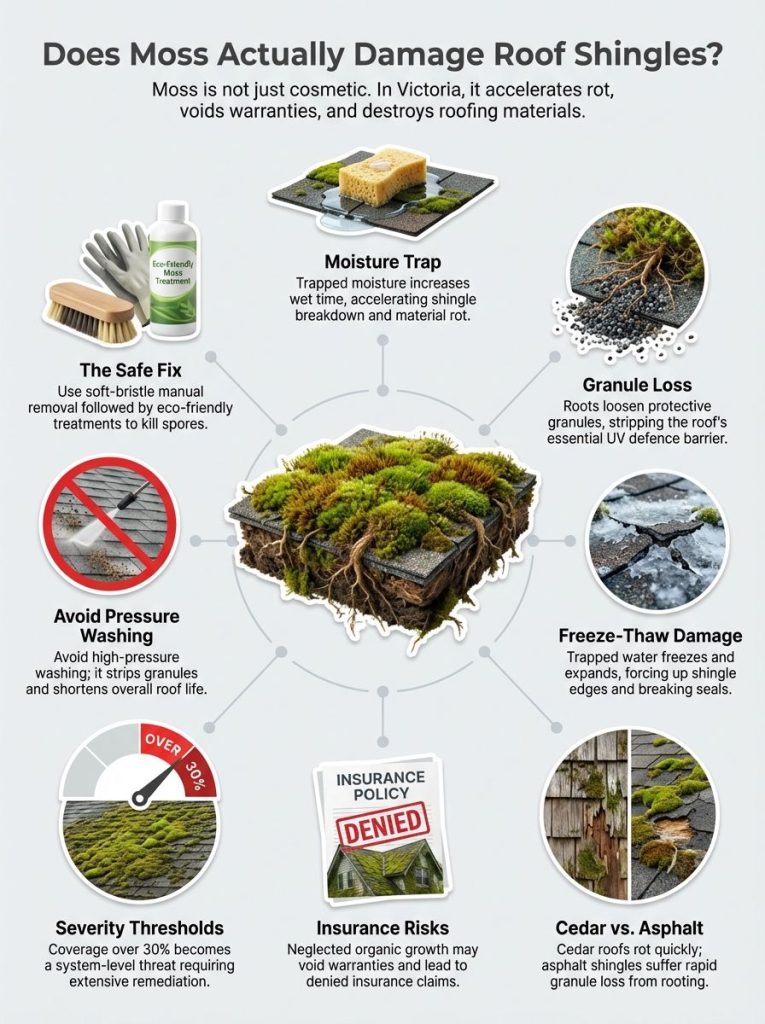
- Warranties Are Strict: Most manufacturing defects warranties specifically exclude damage caused by moss or organic growth.
- Water is the Enemy: Moss acts like a wet sponge. It holds moisture against the asphalt, causing it to rot and degrade 3x faster than a dry roof.
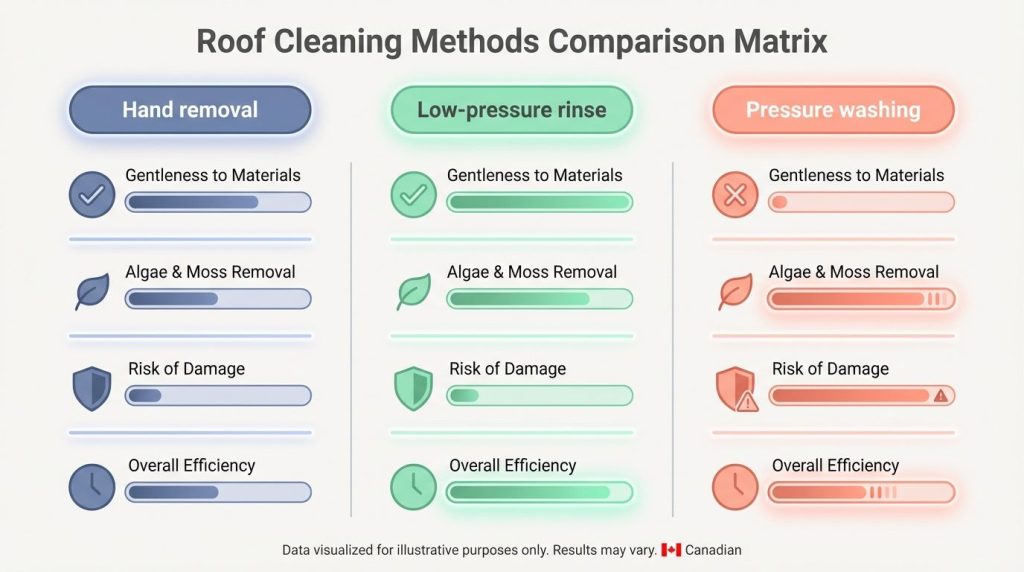
- Pressure Washing is Risky: High pressure strips the ceramic granules (your roof’s UV protection). Once those are gone, the shingle dries out and cracks.
- Winter Makes it Worse: In Victoria, wet moss freezes at night. This expansion pries shingles apart and cracks the seals (The Freeze-Thaw Cycle).
- Prevention Pays: Treating early stage moss (Stage 1) costs pennies compared to the dollars required for a full roof tear-off.
The Short Answer: Yes, It Destroys Roofs
Let’s not overcomplicate this. If you are living in Colwood, Saanich, or anywhere in Greater Victoria, moss is not just a cosmetic issue. It is a physical threat to the structural integrity of your home.
I have spent over a decade in renovation and maintenance here. The pattern is undeniable: Moss keeps your roof wet, and wet roofs die young.
While a little green fuzz looks “rustic” to some, it acts as a sponge. A clean asphalt roof dries out within an hour of a rainstorm stopping. A mossy roof stays saturated for days. That prolonged moisture exposure is exactly what your shingles were designed to resist, but they cannot win a war of attrition against a wet sponge sitting on their face 24/7.
Below, I break down exactly how the damage happens, the specific risks for our local climate, and the math on why fixing it early is cheaper than a new roof.
The Mechanics of Damage: How Moss Actually Breaks Your Roof
We see the same three problems on almost every inspection in Victoria. Instead of repeating them loosely, let’s look at the physics of what is happening up there.
1. The “Sandbox” Effect (Granule Loss)
Asphalt shingles are essentially fiberglass mats coated in asphalt and topped with ceramic granules. Those granules are your roof’s sunscreen. They block UV rays that would otherwise dry out and crack the asphalt.
Moss growth combined with constant moisture weakens the bond between the asphalt and the granules. When you eventually remove that moss—especially if you are aggressive—the granules come off with it.
- The Result: You find piles of colored sand in your gutters.
- The Damage: Once those granules are gone, the sun hits the raw asphalt, causing it to become brittle and crack. You effectively lose years of UV protection in a few seasons.
2. The “Pry Bar” Effect (Lifted Shingles)
Moss naturally seeks shade and moisture. This means it loves to grow in the slots between shingle tabs and along the edges. As the moss clump gets bigger, it physically wedges itself under the shingle above it.
- The Result: The shingles are pushed upward.
- The Damage: This breaks the adhesive seal strip that bonds the shingles together. This seal is what prevents wind uplift. Once that seal is broken, the next big Juan de Fuca windstorm can easily tear those shingles off. You are creating a wind-catcher out of a flat surface.
3. The Freeze-Thaw Cycle
This is specific to our Victoria winters. We hover constantly around the freezing point (0°C to 5°C). We get wet days followed by cold nights.
- The Mechanism: Moss holds water like a reservoir. When the temperature drops at night, that trapped water freezes. Water expands when it freezes.
- The Damage: If that wet moss is wedged under a shingle or inside a crack, the ice expansion pushes everything apart further. It is slow-motion jackhammering on your roof materials. This is why knowing the best time of year to remove moss matters—you want to tackle this before the freezing nights set in.
Severity Scale: When to Worry & What It Costs
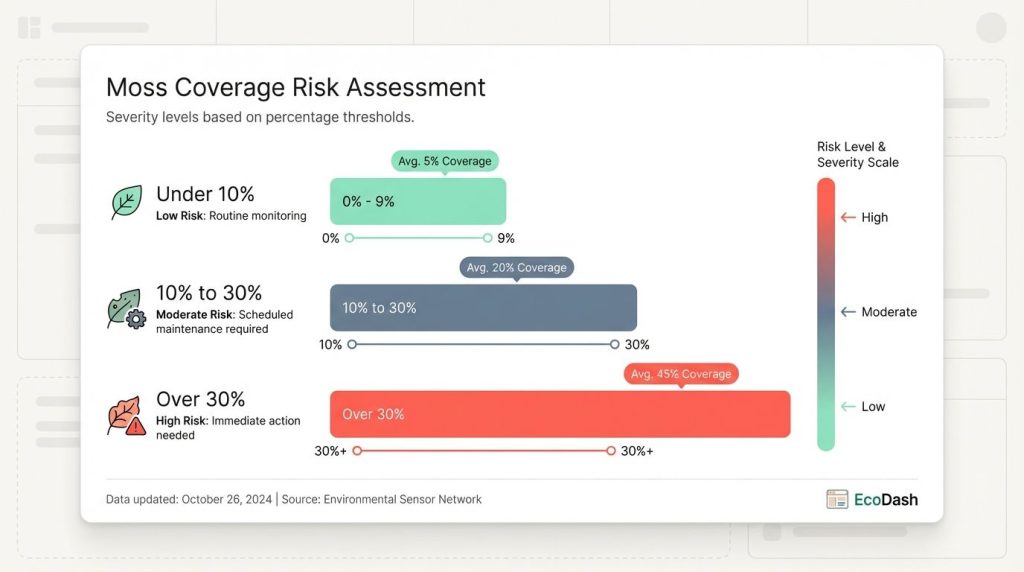
Not all moss coverage is an emergency, but every level of coverage has a different financial implication. I use this severity scale to help homeowners decide if they need a cleaning or a full roof inspection.
The Moss Severity Matrix
| Coverage Level | Visual Indicators | The Real Risk | Required Action |
|---|---|---|---|
| Stage 1: <10% | Green fuzz on shingle edges, mostly north-facing. | Low Immediate Risk. Mainly cosmetic, but moisture is starting to linger. | Spot Treatment. Apply a moss killer or zinc sulfate treatment now to stop the spread. |
| Stage 2: 10-30% | Distinct clumps (biscuits) forming. Valleys have visible debris dams. | Moderate Risk. Granule loss is active. Shingle edges are starting to lift. Gutter flow is likely restricted. | Full Removal. Hand-brushing or soft-wash required. Gutters need flushing. |
| Stage 3: >30% | Thick carpets of moss. Moss growing under laps. | High Risk. Seal strips are likely broken. Water may be tracking sideways under shingles (capillary action). | Critical Intervention. Aggressive but careful removal needed. Roof inspection recommended to check for soft decking. |
The Financial Reality
Let’s talk numbers. In 2025, a standard roof cleaning in Victoria ranges from $0.20 to $0.70 per square foot. For an average home, you are looking at $500 to $1,500. You can see exactly what is included in a roof moss removal service to understand where that money goes.
Compare that to a roof replacement. A new roof in Victoria currently runs $8 to $12 per square foot, though this varies wildly depending on roof pitch, access, and how many layers need to be torn off.
- Cleaning cost: ~$1,000
- Early replacement cost: ~$15,000+
If you ignore the moss and it cuts your roof’s life short by 5 years, you just burned thousands of dollars in value. Maintenance is not cheap, but neglect is expensive.
Material Matters: It’s Not Just Asphalt
While most of us have asphalt shingles, the damage hits other materials differently. Here is the breakdown for the other common roof types in our area.
Cedar Shakes: The Rot Risk
Cedar is organic. It needs to breathe. Moss on cedar is a disaster because it prevents the wood from drying out.
- The Issue: Permanent dampness leads to wood rot, not just surface wear. Moss roots can penetrate deep into the fibers of the shake.
- The Fix: You cannot pressure wash cedar heavily without destroying the wood grain. This requires chemical treatment and extremely gentle handling.
Concrete & Clay Tile: The “Hidden Leak”
Tiles are durable, but the moss blocks the water channels.
- The Issue: Tiles rely on water flowing effectively down their channels. If moss creates a dam, water backs up and flows sideways over the water-lock, getting onto the felt underlayment.
- The Fix: The tiles themselves won’t rot, but the underlayment will rot out from underneath them. Clearing the channels is mandatory.
Metal Roofs: The Seam Trap
Metal is generally moss-resistant, but “slime” and algae still form.
- The Issue: Moss grows on the organic debris (pine needles, pollen) trapped behind screws or standing seams. This traps moisture against the fasteners, leading to rust and washer failure.
Victoria Action Plan: The Right Way to Fix It
If you have read this far, you know the moss needs to go. But how you remove it matters more than if you remove it. For a deep dive, read our guide on how to remove moss from your roof.
Step 1: Manual Agitation (The Heavy Lifting)
Forget the pressure washer. The safest way to remove bulk moss is by hand or with a stiff nylon brush. You want to knock the “heads” off the moss without scrubbing the grit off the shingle.
- Technique: Always brush down the slope of the roof. Never brush up; you will lift the shingles and pack debris underneath them.
Step 2: Chemical Termination (The Roots)
Brushing only gets the visible green stuff. The roots (rhizoids) and spores are still there. You need a treatment to kill the organism. Choosing the best moss killer for roofs is key here—you want something that targets the plant without destroying your home’s exterior.
- Option A: Zinc Sulfate. The classic white powder. Effective, but toxic to fish and plants if runoff isn’t managed.
- Option B: Liquid Oxidizers. These provide instant results but require careful handling to avoid bleaching your siding or killing your prize hydrangeas. For more details on products, check our review of the best roof moss removal sprays.
- Option C: Bleach Mixes? Be Careful. While industry guidelines exist for using specific bleach dilutions to treat algae, you need to be precise. Generic “dumping bleach” is reckless—it can corrode aluminum gutters and ruin soil biology. Use industry-recommended mixes and flood your garden plants with water before and after to protect them.
Step 3: Prevention (The Long Game)
Once the roof is clean, keep it that way.
- Zinc Strips: Installing a zinc strip at the roof peak releases zinc ions every time it rains, inhibiting growth. It’s not a cure-all, but it helps.
- Trim the Trees: Moss needs shade. If you have a Douglas Fir branch hanging directly over your roof, you are fighting a losing battle. Pruning back branches to increase sunlight and airflow is the single most effective prevention method.
Safety & Regulations: Don’t Be a Hero
I need to address the DIY aspect. In BC, if you are working at a height of 3 meters (about 10 feet) or more, fall protection is mandatory.
Roofing is dangerous. Wet moss is essentially ice. It is incredibly slippery. Every year, homeowners in Victoria end up in the ER because they thought they could just “hop up there real quick” to sweep a valley.
- WorkSafeBC Standards: Professionals are required to use harnesses, rope grabs, and anchors.
- The DIY Risk: If you do not have a proper anchor point and a harness you know how to use, stay off the roof. It is not worth a spinal injury to save $600.
Frequently Asked Questions (FAQ)
Q: Can I just use Tide or laundry detergent? A: No. Laundry detergent is designed to pull grease out of fabric, not kill a plant with a root system. It will make your roof dangerously slippery and the phosphates in it are terrible for the local Victoria waterways.
Q: Will the moss just go away in the summer? A: No. It goes dormant. It turns yellow and crunchy, but the roots are still locked into your granules. As soon as the October rains hit, it greens up and keeps growing.
Q: How often do I actually need to do this? A: If you have trees nearby, plan for every 2 years. If you are in a sunny spot in Saanich with no overhanging branches, you might go 4-5 years between treatments.
Q: Does copper wire work as well as zinc? A: Yes, copper works similarly by releasing ions that inhibit growth. However, copper is significantly more expensive than zinc strips and can stain light-colored shingles.
Q: My roof is 15 years old, should I bother cleaning it? A: It depends. If the shingles are brittle and curling, aggressive cleaning might finish them off. In that case, save the $800 cleaning fee and put it toward the replacement fund. If the shingles are still flexible but just dirty, cleaning extends their life.
Final Verdict
Does moss damage shingles? Absolutely.
It is a slow, quiet destruction that targets the granules, the seals, and the decking. By the time you see a leak in your ceiling, the damage has been happening for years.
Treat moss removal as a necessary utility, just like changing the oil in your car. You don’t do it because it’s fun; you do it because it protects your investment.
- Check your gutters.
- Look for the piles of sand.
- Get the moss off before it lifts your shingles.
If you are unsure about the severity, or confused about moss removal vs roof cleaning, get a professional opinion. Most reliable contractors in Victoria will give you an honest assessment.
Ready to save your roof? Get a Quote today. Just remember: keep the pressure washer in the garage.